
I will never forget sitting on my bathroom floor at 2 AM, crying while my newborn screamed in the next room and my husband slept through it all. In that moment, I thought, “Is this what marriage after kids is supposed to feel like?”
If you have had similar thoughts, you are not alone. Research shows that only 38% of married mothers report high satisfaction compared to 62% of married women without kids. However, here’s what I have learned as a relationship coach—your marriage after having a baby does not have to become a casualty of parenthood.
Why Marriage After Kids Feels So Different
When I became a parent, I expected sleepless nights and diaper changes. What I did not expect was how fundamentally my marriage would shift. One day, you are planning date nights; the next, you are arguing about whose turn it is to change the diaper.
The Reality of Marriage After Kids: What Research Shows
A 2021 study from the University of Bonn found that relationship satisfaction naturally declines over the first 10 years together, but parents experience even steeper drops than couples without children. Understanding this is not pessimistic—it’s about setting realistic expectations.
When you know that struggling is normal, you stop thinking something is uniquely wrong with your relationship. According to the Pew Research Center, modern parents face unprecedented pressures from social media comparisons to increased financial demands that previous generations did not experience.
From Partners to Roommates: What Really Happens
In my experience working with couples, this is the phrase I hear most: “We feel like roommates, not partners.” After having kids, most conversations revolve around logistics. Who’s picking up from daycare? Did you pay the electric bill?
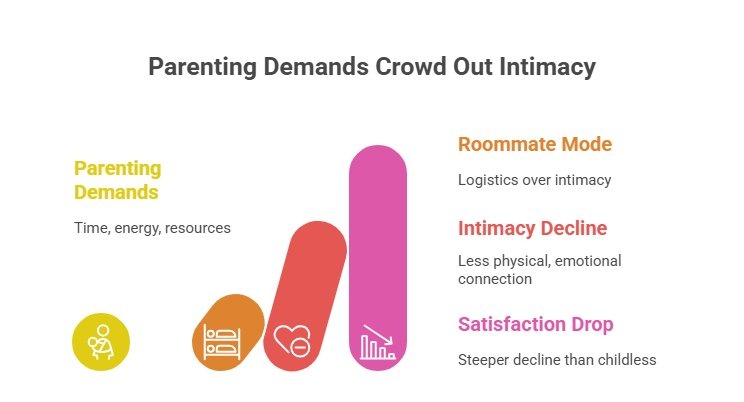
The intimate conversations disappear. You are both so exhausted that by bedtime, all you want to do is collapse. I have discovered this “roommate mode” happens gradually, which makes it dangerous.
What’s really happening is that all those protective factors—quality time, physical intimacy, deep communication—get crowded out by parenting demands. The National Institutes of Health reports significant declines in relationship quality during the first year of parenthood.
Common Challenges
Through relationship counseling and my own experience, I have identified the challenges that hit hardest. Understanding these helps you prepare instead of being blindsided.
Sleep Deprivation and Constant Exhaustion
This one nearly broke me. I am talking about the kind of tired where you cannot remember if you brushed your teeth. Chronic sleep deprivation does not just make you foggy—it changes how you interact with your partner.
The American Psychological Association shows that sleep deprivation increases anxiety, depression, and irritability. In my marriage, after the baby, I snapped at my husband over things that normally would not bother me. A cup left on the counter felt like he did not care about all my work.

That was not about the cup. That was about running on three hours of sleep for weeks.
Here’s what I discovered: when you are exhausted, your brain cannot process emotions properly. You misread your partner’s tone. Small disagreements escalate because neither of you has the bandwidth to step back.
Unequal Division of Childcare Responsibilities
This comes up in nearly every couple’s therapy session I facilitate. One partner feels like they are doing everything while the other feels unappreciated. It breeds resentment faster than almost anything. The problem often is not that one partner is lazy.
It’s that invisible labor is not actually invisible to the person doing it. According to the Journal of Marriage and Family, mothers spend significantly more time on childcare than fathers, even when both work full-time.
Beyond hours, there’s the mental load—remembering appointments, knowing when kids need new shoes, and planning meals. In marriage counseling, I teach couples to make invisible work visible. Write down every task. Every responsibility. You’ll both be surprised by how much there is.
Loss of Physical and Emotional Intimacy
Let me get real about intimacy after having children. Your body has been through something major. You might be touched out from nursing all day. Your partner might feel rejected when you pull away. The Centers for Disease Control and Prevention notes that postpartum recovery takes time, including emotional and physical readiness.
What I wish someone had told me: intimacy looks different after having kids, and that’s okay. It doesn’t mean your relationship is dying. Couples who successfully navigate this focus on non-sexual connection first. Holding hands. Hugging for more than three seconds. Sitting close on the couch. These small touches rebuild the bridge when you’re both ready.
Proven Strategies
Here’s where I want to give you hope. Yes, marriage after kids is hard. But countless couples, including my own, come out stronger. These strategies are not a theory. They are what actually works in the trenches.
Communicate Openly and Check In Daily
You must talk to each other. Not just about logistics, but about feelings. In my marriage after kids, we started a five-minute check-in every evening. Turn off phones, look at each other, and ask, “What was the hardest part of your day? What was the best part?”

This practice does something powerful. It forces you to see your partner as a person, not just the other parent. The Gottman Institute shows that couples who maintain regular emotional check-ins report higher satisfaction.
Here’s what I tell couples in relationship counseling: do not wait for problems to communicate. Make it daily. When something bothers you, say it soon, not after weeks of resentment. Use “I feel” statements instead of “You always” accusations.
Share Parenting Responsibilities Fairly
I have learned that “fair” does not always mean “equal,” but both partners should feel the load is balanced. Couples who thrive after having kids explicitly discuss division of labor instead of assuming things will work out.
Sit down and list everything that needs to happen in your household. Who does bedtime? Who handles appointments? Who remembers birthday presents? The U.S. Bureau of Labor Statistics identifies unequal distribution as a major source of marital dissatisfaction.
Here’s what works: rotate challenging tasks. If one person always handles the witching hour while the other gets the easier morning, swap it. You will both develop an appreciation for what the other deals with.
Couples counseling can be invaluable here. Sometimes you need a neutral third party to help you see patterns you’re too close to recognize.
Schedule Quality Time Together (Even 5 Minutes Counts)
People always say, “Go on date nights,” and honestly, that advice used to annoy me. When you can barely afford childcare and you are exhausted, elaborate dates feel impossible. Here’s what works: micro-moments of connection. You do not need fancy reservations.
Some of my best moments in my marriage after kids have been sitting on the porch after bedtime, sharing a beer, and actually talking. The American Association for Marriage and Family Therapy emphasizes that consistent small connections often matter more than occasional grand gestures. Make time together non-negotiable, even if it’s brief.
Protect it like an important meeting. When you can swing it, yes, leave the house. Remember what it feels like to be a couple. But on the daily grind, find small pockets of togetherness. They add up to more than you think.
Seek Professional Help for Your Marriage After Kids
I am a big believer in couples therapy, not just when things are falling apart. Think of marriage counseling like preventive healthcare. You get annual physicals when you feel fine, right? The same logic applies here.
Here’s when it’s definitely time for professional help: if you are having the same fight repeatedly with no resolution, if you feel more like enemies than partners, if resentment has built up so much that you cannot have calm conversations, or if either of you is considering separation.

According to the National Institute of Mental Health, seeking help for relationship challenges is a sign of strength. It shows you value your marriage enough to invest in it.
Finding the right therapist matters. Look for someone who specializes in couples therapy with experience in the transition to parenthood. Many offer virtual sessions now, which are easier to manage with kids at home. Don’t be afraid to try different providers until you find the right fit.
How long does it take for a marriage to adjust after having kids?
In my experience, the first year is the hardest, but full adjustment can take 2-3 years. Every couple’s timeline differs, and adding more children resets parts of that process.
Is it normal to fight more after having a baby?
Absolutely. Research shows conflict increases significantly after having children due to sleep deprivation, new stressors, and lifestyle changes. Fighting more does not mean your marriage is doomed.
How can I reconnect with my spouse after having kids?
Start small with daily five-minute check-ins, express gratitude for specific things your partner does, and prioritize any quality time together, even just 15 minutes after the kids sleep.
What percentage of couples struggle after having kids?
Studies indicate approximately 67% of couples experience declining relationship satisfaction within three years of becoming parents, so struggling is far more common than thriving initially.
Conclusion
Look, I am not going to sugarcoat it. Marriage after having kids is one of the most challenging things you will navigate. There will be moments when you question everything, when you feel more alone than you have ever felt.
But here’s what I know now: those hard moments do not define your entire story. With intentional effort, open communication, and willingness to adapt, your relationship can emerge stronger than before. The couples I work with in relationship coaching who thrive are not the ones who never struggle.
They are the ones who face struggles together, seek help when needed through marriage counseling or couples therapy, and refuse to let parenthood erase their identity as partners. Your marriage after a baby deserves that same commitment and care you are pouring into your children.