
I will never forget the day my friend Sarah called me, her voice cracking with frustration. “I do not understand him anymore,” she said about her 11-year-old son. “It’s like I am living with a stranger.” I have heard this story dozens of times from mothers who feel like they are losing their connection with their boys.
Nature of the Mother and Son Relationship
In my years working with families, I have seen firsthand how the mother-son relationship shapes everything from a boy’s confidence to his future marriage. According to research on attachment theory, the mother-child bond forms the basis for later relationships and self-esteem.
Mothers often underestimate their influence. You are not just raising a boy; you are showing him what a strong, loving woman looks like. You are teaching him about:
- Emotional intelligence and empathy
- Respect for women and healthy boundaries
- How to communicate feelings effectively
- What genuine love and support look like
Understanding the Bond Between Mother and Son
Here is something that blew my mind when I first learned it: scientific studies show that a son’s DNA can actually cross the blood-brain barrier and remain in his mother’s brain. This is not only emotional bonding; it is biological. The connection between mother and son is literally written into your cells.
Mothers often describe feeling physically connected to their sons. in ways they cannot quite explain. That’s not your imagination. This bond is often described as “molecular” in nature, creating:
- An intense, physical connection different from other relationships
- Deep protective instincts that feel almost primal
- An intuitive sense of when something’s wrong
- A lasting biological link that persists throughout life
How Mother to Son Relationship Shapes a Boy’s Future
Impact on Emotional Intelligence and Self-Esteem
In my experience, boys who have strong relationships with their mothers grow into emotionally intelligent men. Research indicates that a strong mother-son bond enhances emotional intelligence, self-esteem, and self-control.

These are not just nice-to-have qualities—they are essential for success in relationships, careers, and life.
When the mother-son relationship is strained or unhealthy, boys often struggle with:
- Chronic insecurity and self-doubt
- Feelings of guilt and shame
- Attachment anxiety in adult relationships
- Difficulty trusting others or forming close bonds
Influence on Future Romantic Relationships
Here’s what surprised me most: the way men act and react towards their mother is often the same way they will act and react towards their future spouse or partner. Your son is watching how you handle stress, how you communicate, and how you set boundaries. He’s learning what to expect from women and how to treat them.
I’ve counseled countless couples where the husband’s relationship with his mother directly impacted his marriage. The relationship between a mother and son literally shapes:
- His capacity for intimacy and vulnerability
- How he handles conflict with women
- His expectations in romantic partnerships
- Whether he can balance closeness with independence
Developmental Stages: Nurturing the Relationship Between Mother and Son
Early Childhood: Building the Foundation
Understanding your son’s developmental stage changes everything. Between ages 2 and 4, boys are “Explorers”—full of energy, naturally curious, and self-determined. They need boundaries to feel safe, but those boundaries have to be realistic. You cannot expect a three-year-old boy to sit quietly for 30 minutes.
What Explorers need from you:
- Clear, consistent boundaries that make them feel safe
- Space for active play and physical expression
- Understanding that they’re wired differently from girls
- Patience with their endless questions and curiosity
Then comes what I call the sweet spot: ages 5-8, when boys become “lovers”—more tender, relational, and sensitive to others’ feelings. This is when your son might prefer hugs over roughhousing, and that’s perfectly fine.
- Mercy and understanding as they navigate school demands
- Routine and consistency in daily life
- Quality time with both parents, especially dad
- Space to develop relationships and friendships
Adolescence: Navigating the Challenges in Son and Mother Relationships
Here’s where things get real. Ages 9-12 mark the “Individual” stage, when boys experience major hormonal and emotional shifts. Emotionally, your son becomes a wreck—and here’s the kicker: sadness, hurt, fear, and loneliness all come out as anger.

I remember when my friend’s son hit this stage. She took it personally every time he snapped at her. Once I explained that he is not pulling away because he doesn’t love her—he’s testing to see if she can handle him and his changes—everything clicked. She stayed consistent with her boundaries, and their mother-son relationship actually grew stronger.
What individuals need from you
- Straightforward, age-appropriate information about body changes
- Strong parental supervision despite seeming independent
- Outlets to test his developing identity (sports, clubs, hobbies)
- Increased responsibilities to build self-confidence
The teenage years (13-17) are even tougher. Boys at this stage constantly waver between “Am I loved?” and “Can I get my own way?” They need you, but they’ll act like they don’t. Trust me on this: keep showing up anyway.
What Wanderers need from you
- Respected adult mentors beyond just parents
- Physical outlets for intense hormonal energy
- Understanding and mature responses to mood swings
- Firm boundaries, even when they fight them
Signs of a Disturbed Mother and Son Relationship
Recognizing Unhealthy Patterns
Not all son and mother relationships are healthy. When emotional boundaries become blurred or the mother unconsciously prioritizes her needs over her son’s, destructive dependency develops.
I have seen mothers who make their sons into emotional partners, sharing adult problems and expecting emotional support. This role reversal creates several problems:
- Feelings of guilt when the son tries to set boundaries
- Fulfilling maternal expectations becomes his life purpose
- Little room for forming his own identity
- Difficulty with intimacy in adult relationships
Another red flag: some mothers control covertly through guilt, fear, or playing the victim role rather than being openly authoritarian. This manipulation creates men who struggle with:
- Loss of self-efficacy and confidence
- Decision-making weakness and over-dependence
- Chronic insecurity, especially in career and relationships
- Helper syndrome and over-responsibility for others
5 Ways to Build a Relationship with Your Son
Create Space for Open Communication
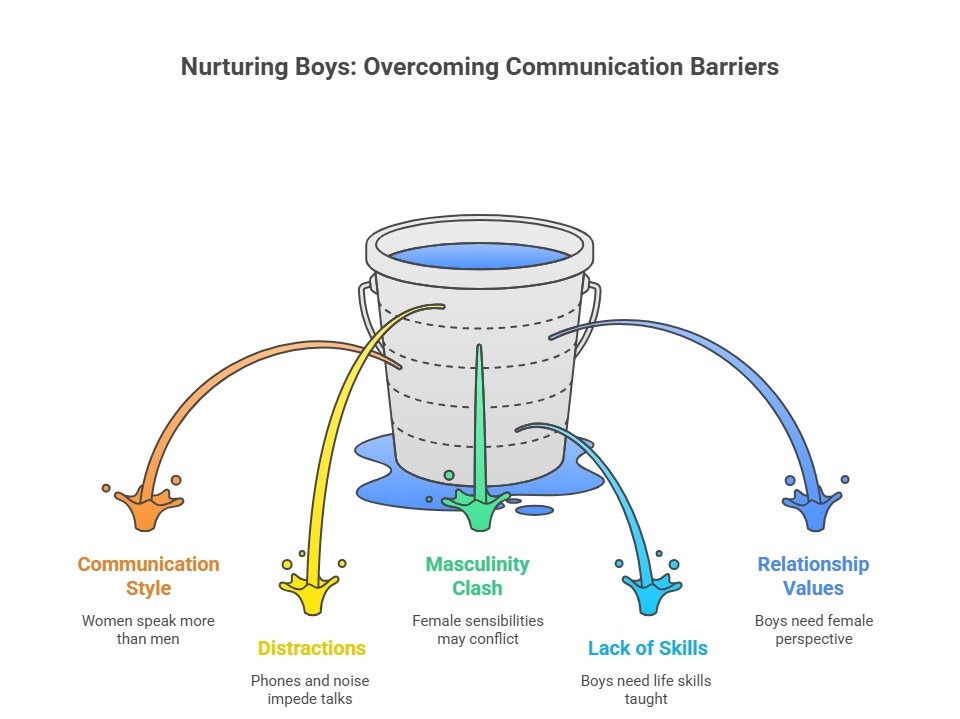
Boys need space to talk, but on their terms. Women naturally speak more words per day than men, so I have learned to get comfortable with silence. Carve out distraction-free time—bedtime for younger boys, walks for older ones—and ask open-ended questions, then listen without filling silences.
Top communication strategies
- Choose side-by-side activities over face-to-face talks
- Ask open-ended questions and wait for answers
- Resist finishing his thoughts or filling awkward silences
- Make time when phones and distractions are away
- Listen more than you speak
In my experience, the best conversations happen side-by-side, not face-to-face. Try driving, fishing, or playing catch. Your son will open up when he does not feel interrogated.
Embrace His Masculinity and Interests
I will be honest: I had to learn this one the hard way. Boys are loud, dirty, smelly, and endlessly hungry—things that clash with female sensibilities.
But those grungy little hands and pockets full of rocks? They are the beginnings of the masculinity that will make him a wonderful husband and father.
Boys bond through activities, not just conversation. Show interest in his passions, even if it means learning about video games or superheroes. It’s not really about the activity—it’s about showing him that what matters to him matters to you.
Ways to embrace his world
- Learn the basics of his favorite sports or hobbies
- Let him teach you about his interests
- Appreciate his energy and physicality
- Don’t constantly criticize mess or noise
- Celebrate his masculine qualities, not suppress them
Teach Life Skills and Relationship Values
Here’s something I wish more mothers understood: don’t leave all the relationship talk to Dad—share your own perspective on what you looked for in a man and what women appreciate. Your son needs to hear from you what respectful, healthy relationships look like.
I also recommend teaching practical skills. Pull your son into the kitchen and teach him to cook. Show him how to do laundry, manage money, and take care of himself.
Essential lessons to teach
- Cooking and basic household management
- How to treat women with respect and kindness
- Financial responsibility and budgeting basics
- Emotional expression and conflict resolution
- What healthy relationships actually look like
How can I maintain a close relationship with my son during his teenage years?
Stay consistent with boundaries while giving him space to grow. Teenagers push away to test if you can handle them. Keep showing up, and stay interested in his life without interrogating.
What are the signs of an unhealthy mother-son relationship?
Watch for emotional role reversal where your son feels responsible for your happiness, difficulty setting boundaries without guilt, or your son struggling with independence and decision-making.
How does the mother-son relationship affect future romantic partnerships?
The mom-son bond becomes the template for how your son relates to women. He learns about communication, emotional expression, and what healthy relationships look like by watching you.
At what age should I start giving my son more independence?
Independence should increase gradually, starting around age 9, when boys enter the “Individual” stage. By ages 18-22, you should be letting go completely—allowing him to manage his own responsibilities, make mistakes, and learn from consequences while knowing he can always come back home.
Conclusion
The mother-son relationship is one of the most powerful bonds in human development. From the molecular connection established at birth to the lasting impact on your son’s future relationships, this bond shapes who he becomes as a man. By understanding developmental stages, recognizing unhealthy patterns, and intentionally building connections through communication and shared activities, you can create a foundation that serves him for life. Remember that the challenges of each stage are temporary, but the lessons you teach about love, respect, and emotional intelligence last forever. Your role as his mother isn’t just about raising a boy—it’s about shaping the man he’ll become and the husband and father he’ll one day be.